Welcome to World Footy News Wednesday, October 28 2026 @ 09:48 am ACDT
 | England | 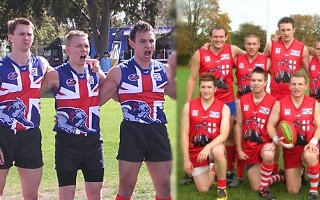 |
This page is a quick snapshot of the status of Australian Football in England (not Great Britain as a whole)). For further information, browse our news items or use the search facility. If you wish to contact football officials from the country, please search our site for links to their leagues or clubs, including in our Atlas. If unsuccessful, we can normally assist with putting people in touch.
Approx population (2009): 52 million
National side: At International Cups, English players have made up the majority of the Great Britain Bulldogs side coordinated by the BARFL/AFL Britain. In recent years there has also been a team coordinated by Aussie Rules UK known as the England Dragonslayers, which has ranged from being drawn from ARUK regional clubs through to being a mix of AFL London and ARUK players.
The clubs from the AFL Britain and ARUK came together in 2010, though the Dragonslayers have continued as a separate entity for events such as the EU Cup. The Dragonslayers are currently coached by Rob Fielder, who is also Assistant Coach of the Great Britain Bulldogs.
Governing body: AFL Britain (formerly BARFL)
Clubs:
| London | Southern | Central/North West | Northern |
|---|---|---|---|
| Dulwich Dragons | Bournemouth Demons | Birmingham Bears | Durham Saints |
| London Swans | Chippenham Redbacks | Huddersfield Rams | Gateshead Miners |
| North London Lions | Portsmouth Pirates | Hull Mariners | Hartlepool Dockers |
| Putney Magpies | Southampton Titans | Manchester Mosquitoes | Newcastle Centurions |
| Reading Kangaroos | Sussex Swans | Nottingham Scorpions | Redcar Bombers |
| Wandsworth Demons | Guildford Crows | Sheffield Thunder | |
| West London Wildcats | Plymouth Seagulls (friendlies only in 2011) | Wolverhampton Wolverines | |
| Wimbledon Hawks | Bristol Dockers (in WARFL 2011) |
| University |
|---|
| Cambridge University |
| Oxford University |
| University of Birmingham Sharks |
| Leeds Met Taipans |
| University of Chichester Cougars |
Primary contact / link: AFL Britain
WFN Census (2004): 18 teams, 435 seniors, 0 juniors
WFN World Ranking (2008): At the International Cups to date, English players have represented Great Britain (equal 9th)
History: England is of course the modern home of most forms of football leading up to the modern branches such as Australian football, Rugby and soccer. It has been reported that Australian rules football was played by a British representative rugby team which toured Australia in 1888, and over the next 100 years there have been numerous examples of expat-Aussies playing in London and elsewhere, including regular Oxford versus Cambridge University matches and a local league in the 1960s supported by celebrities such as Rolf Harris.
VFL/AFL exhibition matches were played in London regularly from the 1970s at The Oval, but have been in hiatus since the mid-2000s due to lack of interest from AFL clubs most likely due to difficulty with the short off-season and the requirement to find sufficient sponsorship.
What could be described as the modern era began with the British Australian Rules Football League (BARFL) in 1989, which quickly established clubs in London and a few in regional England. The inaugural season kicked off in 1990, with five clubs from London (West London, Earls Court, Wimbledon, Wandsworth and North London), and three from regional areas (Lea Valley Saints, East Midlands Eagles & Thames Valley Magpies).
In 2001, the league began introducing different divisions, including a reserve grade for the London clubs and splitting off the regional sides into their own league. The most powerful club of the 21st century has been West London, winning a large percentage of all London premierships and regularly fielding three senior sides and has an affiliated women's netball side.
In 2005 Aussie Rules UK was formed and began a junior program with support from Sport England, and then in 2007 created regional 9-a-side leagues in part overlapping the existing BARFL structure. The BARFL's regional clubs at this point either joined the ARUK competitions (in the case of Middlesboro, Thanet, Swindon and Sussex) or joined the BARFL's London social league (Manchester, Nottingham and Bristol), in what was described by some as a bitter turf war. The next few years saw many clubs established to compete in ARUK regions, with regional leagues being developed in England's northern, central and southern regions.
A number of the players from the ARUK's regional league represented England as the Dragonslayers at the EU Cup, winning that event in both 2008 and 2009, though their official position remained somewhat controversial as the best English players were at the time playing representative football with the AFL Britain's British Bulldogs, the Bulldogs crushing the Dragonslayers by over 20 goals in their only head-to-head encounter.
In 2008 the BARFL agreed to become AFL Britain and create a separate AFL London committee to separate London and regional matters. It was at times suggested that this encouraged ARUK to recognise AFL Britain (which like the BARFL before was affiliated with the world governing body, the AFL), but we have not seen this publicly verified by ARUK. Late 2009 saw what has been suggested to be a sudden departure from England of key ARUK staff, and the clubs competing in ARUK leagues have been in consultation with AFL Britain to produce a unified structure once again.
See also Great Britain
Outlook (2011): The future looks quite bright, with steady growth in the number of senior teams, the possibility that current junior programs may be sustained, and the formation of an AFL-backed European Australian Football Association potentially helping to lead European footy forward. There is now a good level of unity between the former BARFL and ARUK clubs, with the individual regional leagues largely operating independently.
Other points of interest: Fuelling initial growth in footy in Britain has been the enormous number of expat Australians but while it has given the sport a tremendous foothold it is sometimes seen as holding back the further entrenchment amongst locals.
Last Updated: Friday, April 29 2011 @ 07:31 pm ACST| Hits: 7,660 


 RSS news
 Twitter
 Facebook